Log in with a touch
One touch of a fingerprint now opens every door on my self-hosted platform: the git server, every git push,
Building a Signed Software Supply Chain for a One-Person SaaS
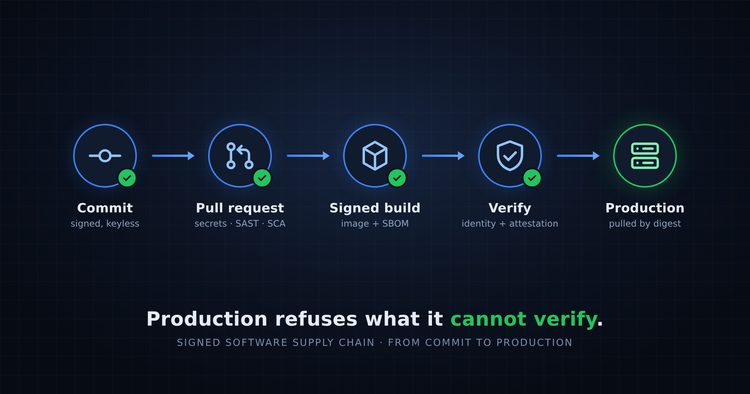
Every commit to my SaaS is now signed by a short-lived certificate, every release is signed by the CI
Configuration Isn't Proof: Five Findings From Auditing My Own Infrastructure
Before building a self-hosted secure development platform, I audited the machines it would run on. Five findings, the fixes, and the pattern behind them.
Do I Really Need a DGX Spark? Running Local AI for AppSec on a Base M5 MacBook Pro with 32GB
A base M5 MacBook Pro ran Qwen3.6 35B at 45–57 tokens/sec, fully on its GPU. Here's why I didn't need a DGX Spark to build my AI AppSec pipeline locally.
How to Stick to 5GHz Wi-Fi on a Home Server (When a Secure Tunnel Is Routing You Through the Wrong Gateway)
I run a small self-hosted setup at home: a Linux server on my local network, connected to a cloud
Building an AI-native security pipeline for Stokum.NET
I wrote before about the zero-trust architecture behind Stokum, encrypted tunnels, JWT auth, row-level tenant isolation, no implicit
StokumNET Threat Model: A Practical STRIDE Analysis
In an ideal world, threat modeling happens before the first line of code. You identify assets, map trust boundaries, enumerate
StokumNET Security Roadmap: From Foundation to Enterprise-Grade
Building a secure multi-tenant platform is never "done." The architecture I described in my previous post established
StokumNET/Architecture: Building a Secure Multi-Tenant Platform
"Stokum" means "my inventory" in Turkish. "Net" means "clear" or "exact.
Why I'm Building StokumNET (And Launching This Blog)
After seven years as a Staff Application Security Engineer at SugarCRM, I stepped away from corporate life to return to